A handoff is not abolished by moving the border
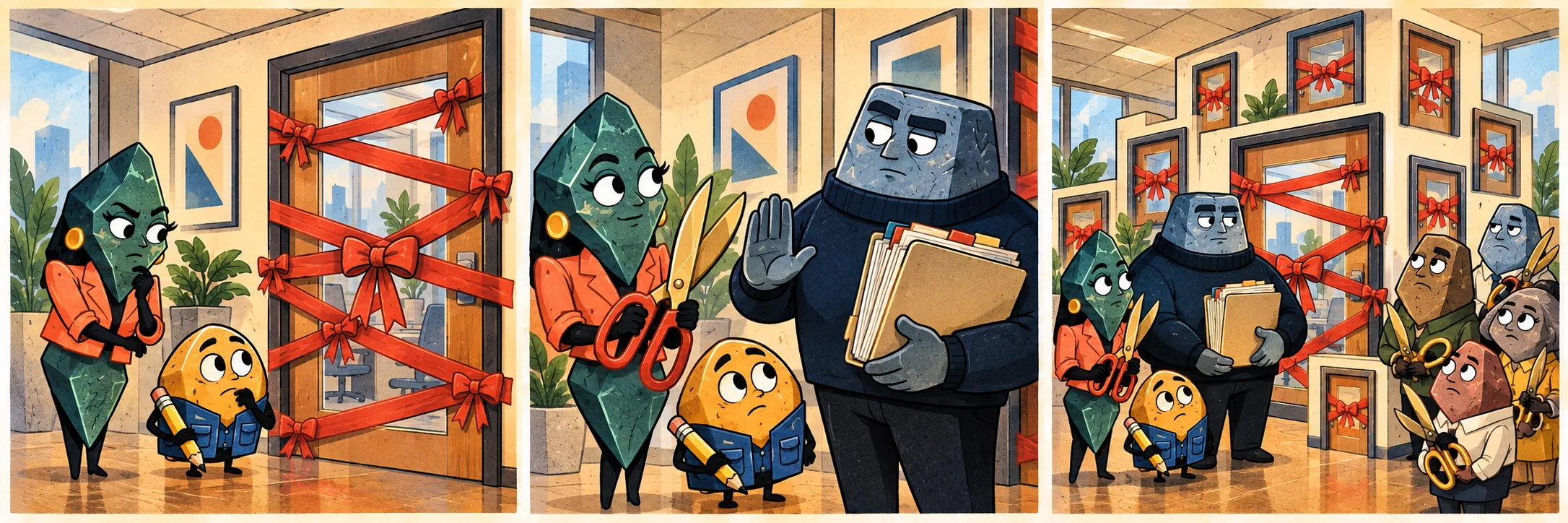
Vera asked who could approve a release. The answer was a diagram containing eleven arrows and one small circle labeled later. We removed the arrows. Chip asked whether security could still hold the release. It could. Finance could too, but its approval had been moved three desks closer.
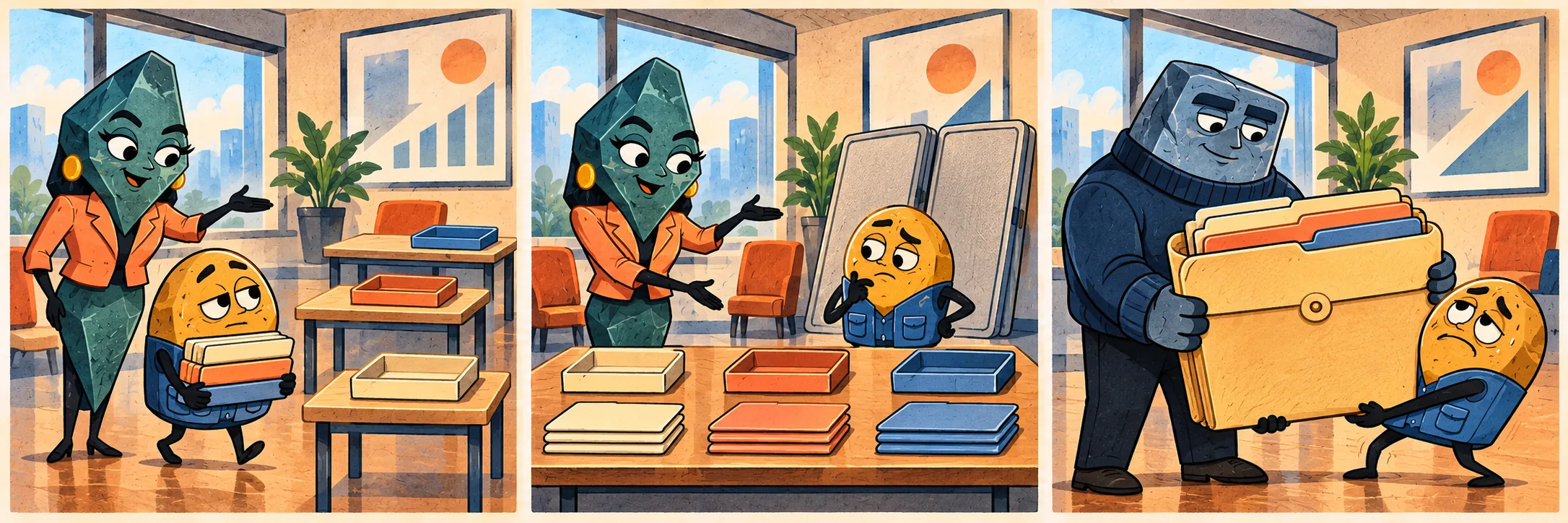
Putting product and platform on the same team can spare an engineer two queues for a routine change. Someone on that team still needs permission to make the call. At SoftBoulders, Chip can now see the person who needs to approve his work. He can also see that person waiting for Finance.
THE FIRM’S WORKING MODEL
The handoff reduction plan
- 01Three teams
Work crosses two visible boundaries.
- 02One organization
The boundaries move indoors.
- 03One owner
The owner requests a larger inbox.
Unresolved decisions return as alignment.
The layer has left the chart
We also simplified management layers. Flint achieved this by deleting the middle row in the presentation. The people in that row had been translating strategy downward and risk upward. Strategy can now descend without translation, while risk has been asked to use the stairs.
The remaining managers received broader spans of control. One now oversees design, delivery, performance, capability, culture and a plant that appeared after the office move. We call this end-to-end ownership because the manager can see both ends from a considerable distance.
Chip asked Flint to approve a release under the new structure. Flint requested a short paper so leadership could confirm that decisions were now faster. The paper went to the same three people who used to sign off on the release.
Small teams need somewhere to put the large decisions
If Chip’s team owns password recovery, let it fix the reset flow without booking time with three managers. Security can still settle questions about who gets back into an account. Give those questions a named approver, then time how long a customer actually waits for a reset.
SoftBoulders has adopted most of this approach. Each team owns an outcome, subject to twenty-seven reserved decisions. The reserved decisions live in a central register owned by nobody, because naming an owner would add a box.
The final chart is a rectangle containing the words everyone together. Flint asked Chip to bring it to the next meeting. Chip asked if he could bring the release for signature as well. Flint said that was a separate meeting.
Behind the brief: Canva’s restructuring and product-organization consolidation
Canva said a restructuring would affect 1,271 people, or 22% of the company, through departures, role changes or relocations. Its plan combines Product, Growth and Platform into one Product Org, reduces management layers and narrower specialties, and concentrates more product work in Sydney. Reuters reported that Canva’s growth had slowed for the first time in a decade. SoftBoulders’ one-box operating model and all workplace scenes are invented.
- Canva: Team update on Canva’s organizational changes Nov 4, 2026
- Reuters via MarketScreener: Canva restructures as growth slows Nov 4, 2026
News date: Nov 4, 2026. Article published: Nov 9, 2026. The policies and proposals in this article are SoftBoulders’ comic response; the linked sources describe the underlying events. Editorial notes.